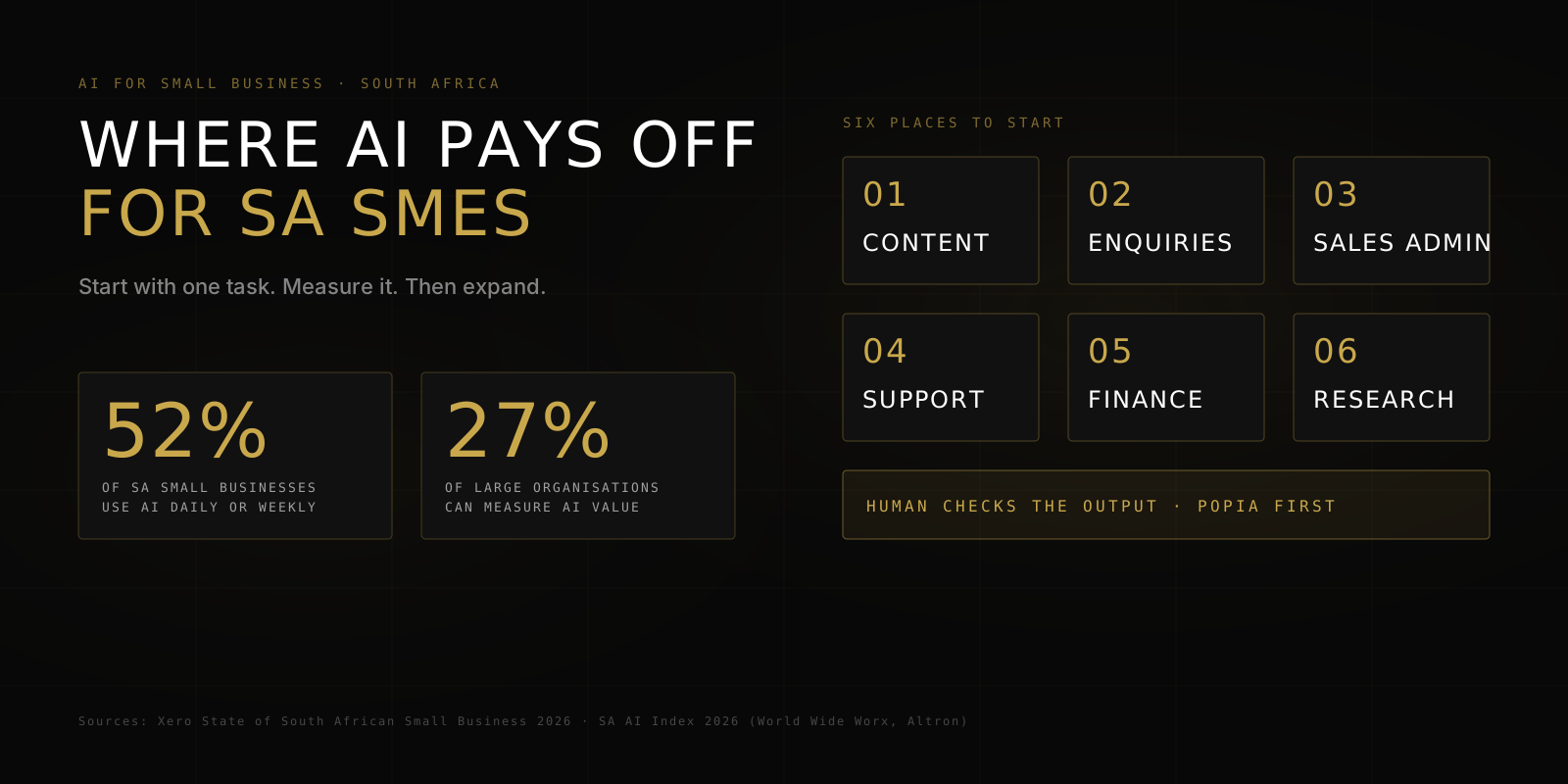
Most South African small businesses are already using AI. The harder question is where it actually saves time or wins work, and where it just creates more things to check. This guide skips the hype and walks through six practical places to start, the guardrails that keep you on the right side of POPIA, and a 30-day plan for proving it pays before you spend serious money.
Where SA Small Businesses Are Right Now
Xero's 2026 State of South African Small Business report found that 52% of small businesses are using AI tools daily or weekly, while 56% want more support understanding how AI applies to their own operations. In its launch release, Xero also reported that 85% of the small businesses surveyed are prioritising digital adoption, using automation and AI to speed up manual processes.
AI daily or weekly
where AI fits
can measure value
That last figure comes from the SA AI Index 2026, which surveyed organisations with more than 200 employees. Almost all of them use generative AI, yet only about a quarter can say whether it is paying off. Small businesses have an advantage here: with fewer people and simpler processes, you can measure the result of one change in a few weeks.
Pick the problem first. The tool comes second.
Anaye Digital EditorialSix Places AI Can Pay For Itself
You do not need an AI strategy document. You need one repetitive, time-consuming task where a good first draft saves real hours. These six areas are where most small businesses find it first.
-
01Marketing Content and Ad CreativeUse AI for first drafts of ad copy, social posts, product descriptions, email subject lines and landing page sections, then edit for your voice and facts. It is fastest for variations: ten headline options in a minute instead of an hour. Our guides on AI prompts for ad creative and when to use AI or humans for creative go deeper.
-
02Customer Enquiries and Follow-UpDraft replies to quote requests, summarise a long email thread before you call a customer back, and write the follow-up messages you never get round to. Pair it with a simple reply routine, like the one in our WhatsApp lead follow-up guide, so speed and quality go up together.
-
03Sales and AdminTurn meeting notes into action lists, draft proposals and quotes from a template, write minutes, and prepare a one-page brief on a prospect before a call. This is often the biggest time saver for owner-managed businesses, because the owner is doing it all.
-
04Customer Support QuestionsAn assistant trained on your own FAQs, price list and policies can answer common questions on your website or WhatsApp after hours and hand anything unusual to a person. Tell customers they are talking to an automated assistant, and make it easy to reach a human.
-
05Finance and BookkeepingMany accounting platforms now build AI into categorising transactions, chasing invoices and summarising cash flow. Use those features to prepare the work, and keep your accountant or bookkeeper reviewing it. AI can sort the pile, but it should not sign off the numbers.
-
06Research and Being FoundUse AI to summarise competitors, outline a content plan or sense-check an idea. Also remember your customers use AI too: tools like ChatGPT and Perplexity now answer questions that used to go to Google. Our guides on getting found in AI answers and AEO versus SEO explain how.
Give It a Role, a Task and Limits
"You are the customer service assistant for [business name], a [type of business] in [suburb]. Draft a friendly reply to the enquiry below in under 80 words. Ask two questions that help us quote accurately. Do not state prices or promise dates. Enquiry: [paste text without names or phone numbers]."
Stay Ahead of the Curve
Practical digital marketing insights for marketers and business owners, no fluff, straight to your inbox.
Guardrails: POPIA and Common Sense
POPIA applies to every South African business that processes personal information, whatever its size, and putting customer details into an AI tool is processing. South African law firms point out that many AI tools are hosted outside the country, so sending customer data to one can count as a cross-border transfer that needs proper contractual protection. Customers who volunteer health or religious details in a chat can also create special personal information with extra obligations.
-
Keep personal details out of prompts. Remove names, ID numbers, phone numbers and account details before pasting text into a free tool. For routine drafting you rarely need them.
-
Check the tool's data terms. Read how the provider stores and uses what you submit, and whether a business plan switches off training on your data. Use business-grade accounts for anything involving customers.
-
Keep a human in the loop. AI can state wrong facts with confidence. Someone should read every customer-facing message, quote and number before it goes out.
-
Be open with customers. If a chatbot is answering, say so, and offer an easy route to a person.
-
Write a one-page rule sheet. List which tools staff may use, what data must never be pasted in, and who checks the output. Our AI use policy template gives you a ready starting point.
This is general guidance, not legal advice. If you plan to process customer data at scale with AI, check your approach with a POPIA-literate adviser.
Three Ways To Get Started
| Option | Best for |
|---|---|
| A general AI assistant (ChatGPT, Claude, Gemini) | Drafting, summarising and research. Low cost, quick to try, and the right place to start for most businesses |
| AI built into software you already use | Accounting, email, documents and ad platforms. Little set-up, and it works on data already in the system |
| A custom assistant or automation | High volumes, such as support chats or lead routing, where it must connect to your CRM or website |
Start with the first row. Only move to custom builds once you know exactly which task you are automating and how much it is worth to you.
A 30-Day Plan To Prove It Works
Measuring is what separates the businesses that benefit from AI from the ones that just feel busy with it. Run one small test, with a number attached.
-
01Week 1: Choose One TaskPick a task that is frequent, repetitive and low risk, such as replying to quote requests or writing social posts. Note how long it takes now, and how many you do a week.
-
02Week 2: Write the Prompt and the RulesDraft your prompt with a role, a task and limits, and agree what a good result looks like. Decide who checks the output before it is used.
-
03Week 3: Run It and Record the ResultUse it on every instance of that task. Track time saved, reply speed, enquiries converted or errors caught, whichever matches your goal.
-
04Week 4: DecideIf it saves meaningful time or wins more work, keep it and add the next task. If not, change the prompt or drop it. Either way, you now have a real number, not a hunch.
Fit AI Into Your Wider Marketing
AI makes the production side of marketing faster, but it does not decide your offer, your budget or your tracking. Your Google and Meta campaigns still need the right targeting and conversion measurement to turn faster content into more leads. If you want a second pair of eyes on where AI could help in your marketing, we are happy to look at it with you.
Start this week. Pick one task, write the prompt, and measure what happens.
Get the Next Guide First
Practical digital marketing insights for marketers and business owners, no fluff, straight to your inbox.
Sources
SA small business AI use and support needs: Zawya, reporting Xero's 2026 State of South African Small Business. Digital adoption priority: Xero media release. Large-organisation AI measurement: CIO Africa, on the SA AI Index 2026. POPIA applies to all businesses: ClearComply. Cross-border transfer and special personal information with AI tools: ENSafrica.