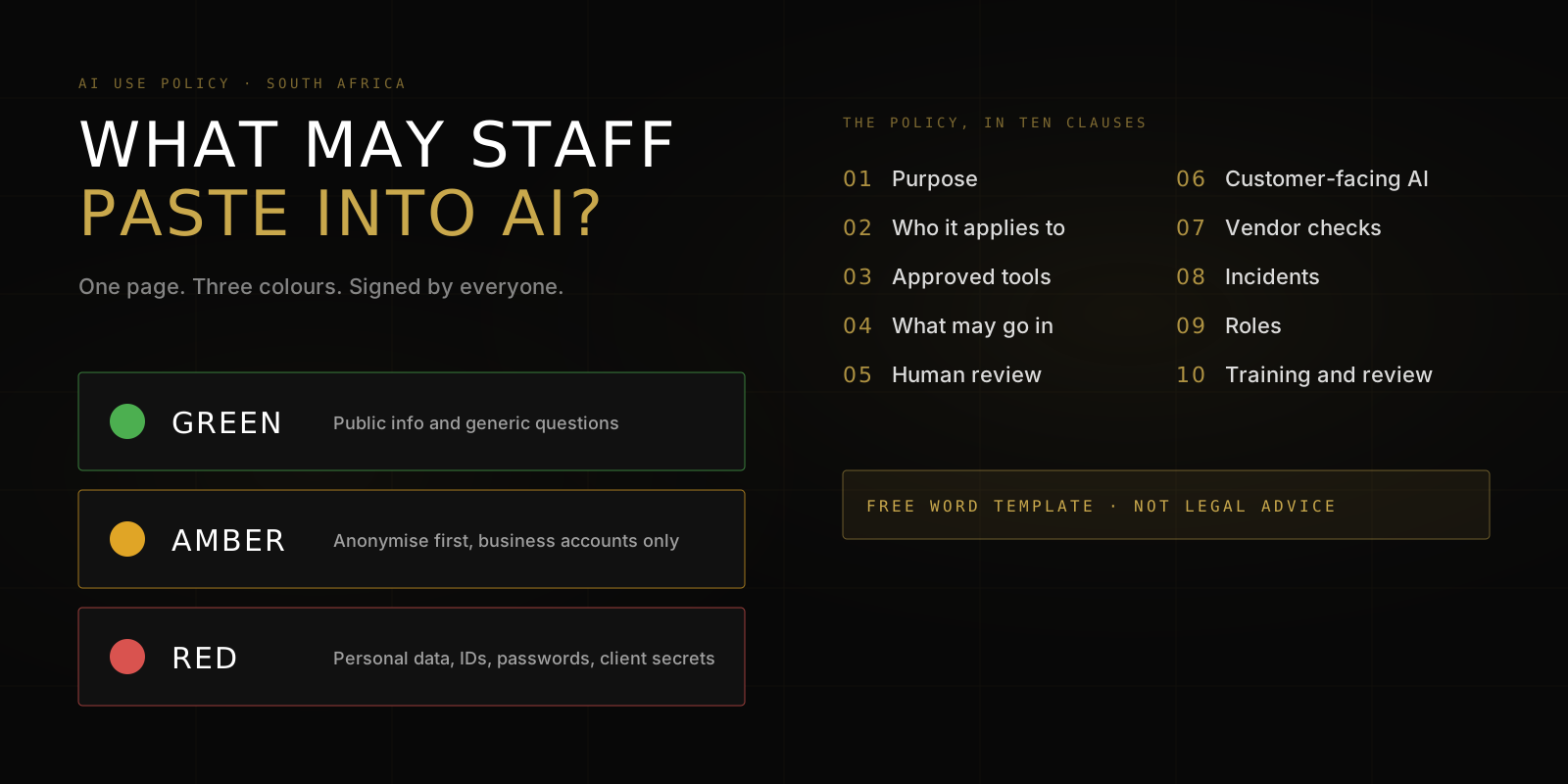
If your team uses ChatGPT, Gemini, Claude or the AI built into your software, you already have an AI policy. It is just unwritten, and everyone has a different version of it. A one-page written policy fixes that. This guide explains what South Africa's POPIA means for AI use in a small business, and gives you a template you can copy, fill in and put in front of your team this week.
Why Small Teams Need One
The risk is rarely a dramatic hack. It is an employee pasting a customer list, a client email or a staff query into a free tool because it is quick. POPIA applies to every South African business that processes personal information, whatever its size, and there is no small-business exemption.
A short policy answers the questions staff would otherwise guess at: which tools are allowed, what must never be pasted in, who checks the output, and who to tell if something goes wrong. It also gives you something to show a customer or auditor who asks how you handle their information.
If it is not written down, everyone has a different policy.
Anaye Digital EditorialWhat POPIA Means For AI Use
You do not need to be a lawyer, but five parts of POPIA shape how a small team should use AI. This is a plain-language summary, not legal advice.
-
You are accountable, and you have an Information Officer. The head of the business is the Information Officer by default. You can delegate the role to a manager, and registration with the Information Regulator runs through its online portal.
-
AI providers are usually your operators. Where a provider processes personal information on your behalf, POPIA section 21 expects a written agreement covering security, confidentiality and breach notification. A vendor with no data processing agreement leaves that gap with you.
-
Sending data abroad needs a lawful basis. Section 72 restricts transfers of personal information outside South Africa. Many AI tools process data overseas, so check where your provider stores it and what protects it.
-
Security must be reasonable. Section 19 requires appropriate technical and organisational safeguards. Free, personal accounts with no business terms are hard to defend for customer data.
-
People can challenge automated decisions. Individuals have the right to ask for human involvement where decisions about them are made automatically, so keep a person responsible for anything that significantly affects someone.
New rules are also on the way: a Draft National AI Policy was published for public comment in April 2026. Review your policy regularly so it keeps pace.
The Simplest Rule: Red, Amber, Green
| Level | What it covers and the rule |
|---|---|
| Green | Public information, your own published marketing content, generic questions, ideas and outlines. Fine to use in approved tools |
| Amber | Internal notes, draft quotes, customer enquiries. Remove names, contact details and account details first, and use business accounts only |
| Red | Customer or staff personal information, special personal information (health, religion, children), ID numbers, passwords, bank details and confidential client material. Never enter without written approval |
Most staff remember a traffic light far better than a ten-page policy. Put it on a card next to their screen.
AI Use Policy Template (Word)
A two-to-three page, fill-in-the-blanks policy for South African small teams. It covers approved tools, the red, amber and green rules, human review, vendor checks, incident reporting, roles and a sign-off page.
Stay Ahead of the Curve
Practical digital marketing insights for marketers and business owners, no fluff, straight to your inbox.
What The Policy Should Contain
Keep each clause to a few lines. The template follows this order, and you can paste these sections into your own document if you prefer.
-
01Purpose and Who It CoversOne short paragraph on why the policy exists, and that it covers employees, contractors and freelancers on any device, whether the tool is free or paid.
-
02Approved ToolsA named list of the tools staff may use. Anything else needs written approval from the Information Officer. Insist on business accounts where the provider offers them.
-
03What May Go Into a ToolThe red, amber and green table above. This is the clause staff will use most.
-
04Human ReviewA person reads and approves every AI-generated customer message, quote or number before use, and a person owns any decision that significantly affects an individual.
-
05Customer-Facing AICustomers are told when they are dealing with an automated assistant, and can always reach a person. Marketing consent and opt-out rules still apply.
-
06Checks Before Approving a ToolA written agreement with the provider, clarity on where data is processed, confirmation your inputs are not used to train public models, and a way to delete and export your data.
-
07If Something Goes WrongStaff report mistakes straight away, without blame, so the Information Officer can decide whether the Regulator and affected people must be told.
-
08Training and ReviewEveryone reads and signs the policy in their first week, and you review it every six months or when your tools or the law change.
Roll It Out In One Week
The policy only works if people know it exists. A simple rollout does the job.
-
Day 1: Fill in the template, choose your approved tools and name your Information Officer.
-
Day 2: Check each approved tool against the vendor checks, and switch on the business privacy settings.
-
Day 3: Run a 20-minute team session using real examples of red, amber and green data.
-
Day 5: Everyone signs. File the signed copies and diarise the six-month review.
This is general guidance, not legal advice. If you handle sensitive information, such as health or children's data, or process customer data at scale with AI, have a POPIA-literate adviser review your approach.
Where This Fits In Your Wider Marketing
A policy lets your team use AI confidently, which is where the time savings come from. Start with our guide to how South African SMEs can use AI without wasting money to choose your first task, and use the policy to keep it safe. If you follow up leads on WhatsApp, our lead follow-up guide covers consent for messaging in more detail.
Get the Next Guide First
Practical digital marketing insights for marketers and business owners, no fluff, straight to your inbox.
Sources
POPIA applies to all businesses: ClearComply. Information Officer role and registration: MJK Inc. Operator agreements under section 21: MJK Inc AI vendor checklist. Section 72 transfers: Michalsons. Security safeguards and AI in the workplace: Bowmans. Automated decisions and AI: Michalsons. Draft National AI Policy: MJK Inc.