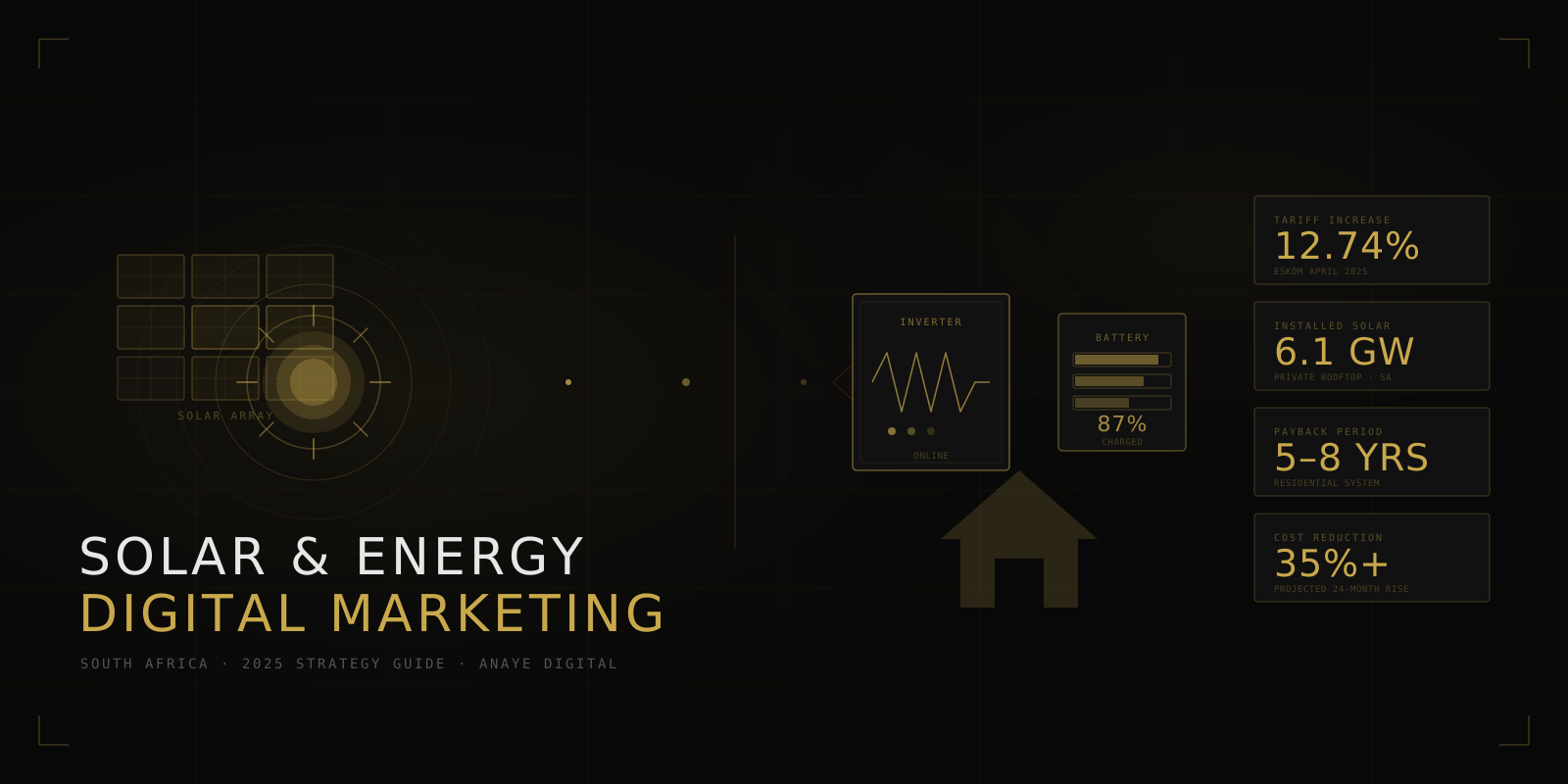
Loadshedding may have eased — Eskom marked 300 consecutive days without outages in early 2025 — but declaring the energy crisis over would be a costly mistake for any South African home services brand. Electricity tariffs are rising by 12.74% in 2025/26, with a further 35% compound increase projected over the next two years. The crisis has simply changed shape. And for electricians, solar installers, plumbers, and home services contractors, the digital marketing implications of that shift are significant — and deeply misunderstood.
The Demand Shift: What Changed and What Didn't
At the peak of loadshedding in 2022 and 2023, the demand driver for solar was visceral and immediate: keep the lights on. South Africa added 2.6GW of solar in 2023 alone. Then loadshedding eased. Residential solar demand dropped an estimated 65–80% from its 2023 peak as the urgency dissolved.
But the fundamentals driving long-term solar adoption didn't disappear. They matured. With Eskom's tariffs approved to compound well above inflation for years ahead — and a December 2025 High Court judgment forcing NERSA to redetermine additional revenue recovery — the economic case for solar is now stronger than the emergency case ever was. The customer's motivation shifted from fear to finance. That changes everything about how you market.
This shift has a direct translation in digital marketing. The Google search terms that drove traffic in 2023 — "solar panels loadshedding," "backup power home" — are declining in volume. The terms that are growing: "solar panel ROI South Africa," "reduce electricity bill solar," "Eskom tariff increase solar system," and critically, "solar installer [suburb]." Your keyword strategy, your ad copy, and your landing page messaging all need to reflect the 2025 customer — not the 2023 one.
Why the Marketing Opportunity Is Still Enormous
Here is what most home services businesses are missing: while residential solar demand dropped post-loadshedding, the commercial and industrial sector barely paused. C&I solar installations declined only 15–20% from their peak — because for businesses, the driver was never purely loadshedding. It was cost reduction, energy security, and increasingly, ESG compliance obligations.
Meanwhile, residential demand is actively recovering. Platforms like Standard Bank's LookSee reported significant increases in solar financing enquiries since mid-2024, driven by rising tariffs rather than power cuts. South Africa added 1.1GW of new solar capacity in 2024 — well down from 2023's peak but still the largest solar addition anywhere in Africa. The pipeline of utility-scale projects, with 2,880MW across 454 projects registered in 2024, signals a sector in structural expansion, not retreat.
in SA — private sector now
matches Eskom output
household from Eskom
zero-fee connection scheme
solar payback period
(shortening with tariff hikes)
The Commercial Accelerant Most Businesses Don't Know About
Section 12B of the Income Tax Act allows South African businesses to deduct the full cost of solar energy investments in the first year of installation. For a commercial client spending R900,000 on a solar system, that's a potential R252,000 tax saving at the 28% corporate tax rate — in year one alone.
This is a powerful sales and marketing message that most solar installers and electrical contractors are not using in their digital advertising. Leading with the tax benefit in Google Ads copy and landing pages consistently outperforms generic "go solar" messaging for commercial audiences.
The Channel Strategy for Energy-Sector Home Services
The right digital marketing mix for a solar installer or electrical contractor in 2025 is not identical to the right mix for a plumber or a cleaning service. The consideration period is longer, the ticket value is higher, and the trust threshold is significantly elevated — customers are spending R80,000–R600,000 on a residential system and need to believe in both the product and the installer before they sign. Here's how the channel strategy should be built.
Stay Ahead of the Curve
Practical digital marketing insights for marketers and business owners — no fluff, straight to your inbox.
Google Search remains the primary lead generation channel for solar and electrical services — it's where purchase-ready customers declare intent. But your keyword strategy must reflect the 2025 market. Emergency-framed keywords ("loadshedding backup") are giving way to economic-framing ("reduce electricity bill," "solar ROI calculator," "best solar system Johannesburg") and compliance-driven terms ("electrical COC," "solar SSEG registration," "DB board upgrade").
Separate campaigns by job type and ticket value. A residential solar installation (R80,000–R250,000) and a commercial DB board upgrade (R15,000–R40,000) require entirely different ad copy, landing pages, and conversion paths. The residential solar prospect wants payback period and financing options. The commercial prospect wants tax deductions and operational uptime. One ad serving both is serving neither well.
Local Services Ads (LSAs) with the Google Guarantee badge are particularly powerful for electrical work — homeowners are cautious about who they let into their properties, and the Google badge reduces that friction measurably. For solar-specific terms in Gauteng and Western Cape, CPCs have risen sharply since 2023 as more installers entered the Google Ads market. Quality Score management (see our plumbing case study) is now essential to maintain efficient CPL.
Google Search SA
social media leads
critical for trust
The extended consideration period for solar makes Meta the ideal top-of-funnel and consideration channel. A homeowner who isn't actively searching for solar today may see a Facebook ad showing their potential electricity bill savings, engage with it, and convert via Google Search three weeks later. Without the Meta touchpoint, your Google ad is competing cold against every other solar installer in the suburb.
Target homeowners aged 30–58 in affluent residential corridors — Johannesburg North, Sandton, Pretoria East, Constantia, Umhlanga — layered with home ownership signals and interests around property, home improvement, and financial planning. Creative that leads with the economic argument ("Your electricity bill just went up 12.74%. Here's how to permanently reduce it.") consistently outperforms solar technical content for cold audiences in the current market.
South African Meta CPMs are genuinely low — R30–R60 per thousand impressions for property-owner demographics. The cost of reaching 50,000 relevant homeowners in Sandton with a brand-awareness video is a fraction of what it costs in equivalent markets. This arbitrage window is narrowing as more advertisers enter the market, but it remains compelling for well-structured campaigns.
audiences in Gauteng
Meta lead forms
prior Meta touchpoint*
*Based on cross-channel attribution data from Anaye Digital client accounts. See our Full-Funnel Playbook for methodology.
For a solar installer or electrician, Google reviews are not just a trust signal — they're a sales prerequisite. A homeowner researching a R150,000 solar investment will read every review on your profile before they call. A competitor with 45 five-star reviews and photos of completed installations will win that call over a competitor with 8 reviews and a blank profile, regardless of pricing.
Build your GBP review strategy around completed installations: a WhatsApp message to every customer within 48 hours of commissioning, with a direct review link, a thank-you note, and — for residential solar — a reminder that their system is now generating savings. Customers who feel the benefit immediately are the most likely to leave enthusiastic, detailed reviews. Those reviews then create the social proof that closes your next job before you ever speak to the prospect.
contacting an installer
for strong conversions
"solar installer [suburb]"
The Creative Strategy That Works in 2025
The most common creative mistake in SA solar marketing right now is running 2023 messaging in 2025. Urgency-led creative ("Don't let loadshedding destroy your business") no longer resonates in a market that has experienced 300 days without outages. The current prospect isn't afraid. They're calculating.
- Lead with the tariff, not the blackout. "Your electricity bill just went up 12.74%. A solar system at current panel prices pays back in 5–7 years and produces free electricity for 25 years." This framing works for cold audiences who have experienced no recent loadshedding but are staring at a higher Eskom bill every month.
- Show real installations, not stock renders. Photos and videos of actual completed jobs in recognisable South African suburbs — Midrand, Fourways, Brackenfell, Durban North — build authenticity that CGI solar panel renders never can. A 60-second video of a homeowner in Centurion explaining their before-and-after electricity bill is worth more than any polished brand film.
- Use savings calculators as lead magnets. A simple interactive calculator ("Enter your monthly electricity spend — see your projected solar savings") consistently outperforms static offer ads for solar lead generation. It gives the prospect a personalised, concrete number, and it gives you a warm, self-qualified lead whose monthly spend you already know.
- For commercial audiences, the Section 12B argument is a headline. "Reduce your tax bill and your electricity bill in the same year" is a message that resonates immediately with business owners. It's undersed by almost every solar installer in South Africa, which means the first business to use it prominently in their Google Ads copy stands out immediately.
- Loadshedding is still a secondary message — not the lead. Despite improved grid stability, the grid remains fragile. Loadshedding returned briefly in early 2025. Positioning your system as protection against the next crisis — while the primary economic case stands on its own — keeps both motivations in play without leading with fear.
The 2023 customer was afraid. The 2025 customer is calculating. Your marketing needs to do the same.
— Anaye Digital Strategy TeamTiming Your Campaigns to the Energy Calendar
South Africa's energy market now has a predictable annual rhythm that smart marketers can plan around. Eskom tariff increases take effect on 1 April each year. This creates a window of heightened financial awareness among homeowners and business owners in the weeks before and after the increase — and it's the highest-intent moment in the solar marketing calendar.
The pattern: February through April sees peak interest in solar ROI searches as consumers anticipate and react to the annual tariff announcement. May through August is winter in Gauteng — lower solar generation, higher heating bills, and grid pressure. October through December brings summer load peaks and a pre-holiday surge in home improvement spending. Each window has a distinct creative angle and audience behaviour, and a campaign calendar built around these cycles outperforms a flat, year-round approach.
Budget scheduling matters too. If your Google Ads budget is fixed monthly, consider concentrating spend in the six weeks around April 1 — when prospect intent is highest and competitor activity, though also elevated, hasn't yet fully absorbed the demand spike. Arriving early in the window with well-structured campaigns and compelling tariff-framed creative gives you a meaningful advantage over competitors who react rather than plan.
Stay Ahead of the Curve
Practical digital marketing insights for marketers and business owners — no fluff, straight to your inbox.