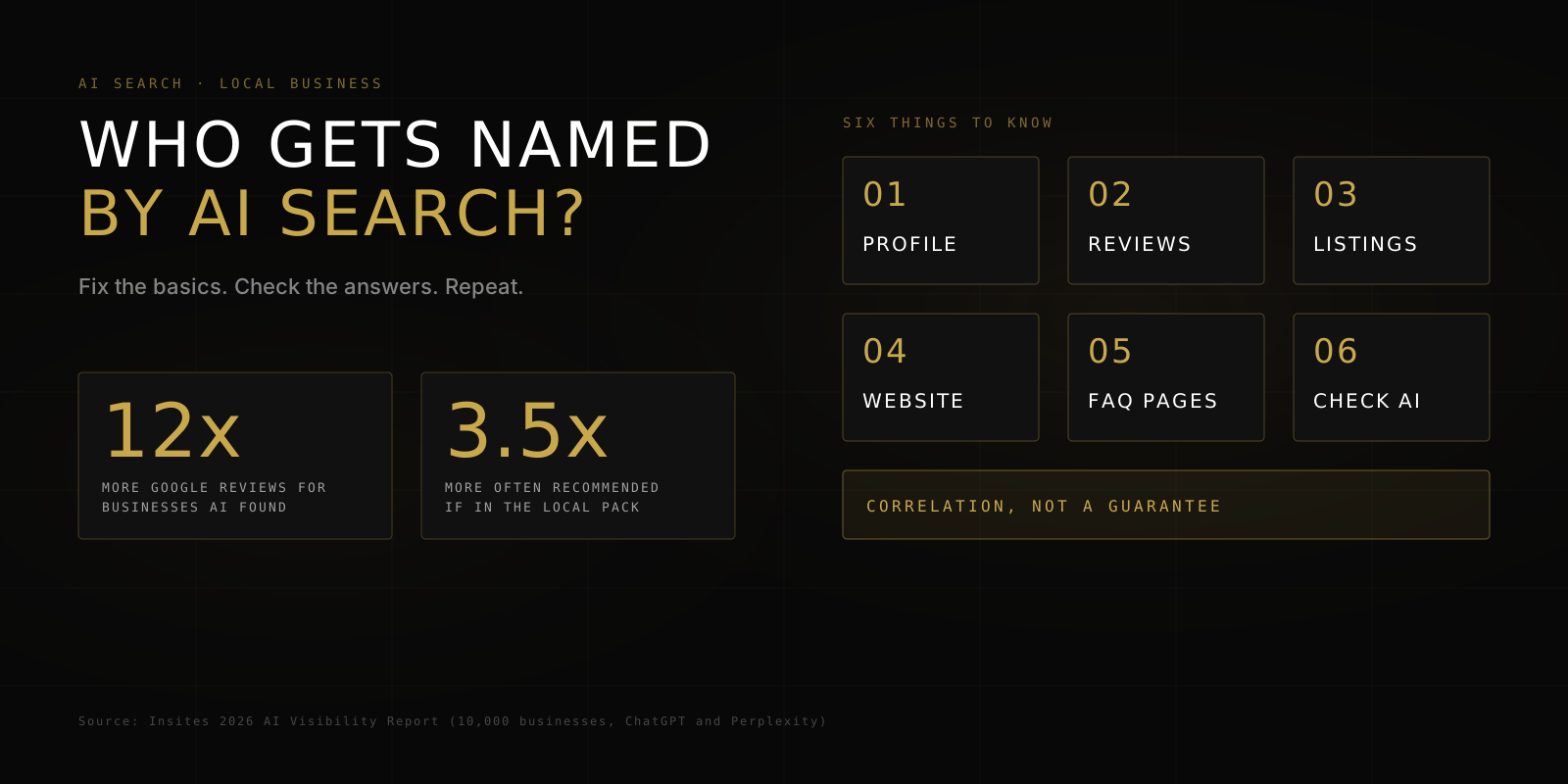
When someone asks ChatGPT, Perplexity or Google's AI "who is a good plumber, dentist or accountant near me?", it names a handful of businesses and ignores the rest. You cannot pay to be named. But the research on who gets named is surprisingly consistent, and most of it comes down to things a local business can fix in a few weeks: a complete Google Business Profile, steady genuine reviews, consistent listings and clear pages on your website.
What The Research Actually Shows
Local SEO company Insites analysed 10,000 businesses across ChatGPT and Perplexity in its 2026 AI Visibility Report. Google review volume had the strongest link to AI visibility: businesses found by both assistants averaged 133 Google reviews, against 11 for businesses invisible to AI. Businesses in Google's Local Pack were recommended 3.5 times more often than those that were not.
businesses AI found
in the Local Pack
matched the real profile
That last number matters as much as the first two. In the same benchmark, only about 56% of ChatGPT results (and 48% for Perplexity) fully matched the business's actual Google Business Profile details. Being known and being described correctly are not the same thing, so wrong hours, phone numbers and services are a real risk.
Treat these figures with care. They come from one vendor's study, they show correlation rather than proof of cause, and they are not South African data. They do line up with how local search has always worked, which is why they are a sensible guide for where to start.
Being named is half the job. Being described correctly is the other half.
Anaye Digital EditorialWhere AI Gets Its Answers
Different assistants lean on different sources, and they change over time. A study of 6.8 million AI citations by Yext, reported by Digital Thrive, found most citations come from sources a business already controls, such as its website and its listings. Another analysis found that, when asked to recommend a local consultant, the assistants build their answers mostly from outside sources: review sites, directories, Reddit threads, local news and the Google Business Profile.
Perplexity shows its sources inline, and ChatGPT shows citations when it searches the web. Rather than guessing, you can ask the assistants about your own business and read the sources they show. That tells you exactly which pages to fix first.
Six Steps You Can Start This Week
-
01Claim and Complete Your Google Business ProfileChoose the right primary category, add every service, real opening hours, photos and a clear description. Insites found profile completeness and Local Pack presence were among the strongest signals. Our Google Business Profile guide walks through each field.
-
02Earn Genuine Reviews, SteadilyAsk every happy customer, make it easy with a short link, and reply to every review. Do not buy, incentivise or bulk-solicit reviews: Google has tightened its review policies against bulk solicitation, incentivised reviews and coordinated campaigns.
-
03Make Your Details Match EverywhereYour name, address, phone number and hours should be identical on your website, Google profile and the directories your customers use. Inconsistent details are how assistants end up quoting the wrong number.
-
04Build One Clear Page Per Service and AreaWrite a plain page for each main service and each area you serve, with real prices or price ranges, who it is for, and answers to common questions. Assistants quote pages that answer the question directly.
-
05Get Mentioned in Places That Corroborate YouIndustry directories, local business associations, supplier pages and local news all confirm that you exist and what you do. A few accurate listings beat dozens of neglected ones.
-
06Check What the Assistants Say, Then Fix ItEvery month, ask ChatGPT, Perplexity and Google's AI about your business and your category in your area. Note what they get wrong and which sources they cite, then correct those sources.
Check Your Own Visibility
"Who are the best [your service] in [your suburb or city]?" "Is [your business name] in [your suburb] any good?" "What are the opening hours and phone number for [your business name]?" Run each in ChatGPT, Perplexity and Google, and screenshot the answers each month so you can see progress.
Stay Ahead of the Curve
Practical digital marketing insights for marketers and business owners, no fluff, straight to your inbox.
What Your Website Should Do
Your site is the one source you fully control, so make it easy to quote. Put your services, areas, prices and contact details in plain text, not images. Add an FAQ that answers real customer questions in a sentence or two. Mark up your business details with LocalBusiness schema if your developer can, and keep your page speed healthy. Our guides on getting found in ChatGPT, Perplexity and Gemini and AEO versus SEO cover the technical side in more depth.
What To Expect
Nobody can promise placement in an AI answer, and anyone who does is guessing. What you can do is remove the reasons you would be skipped: an incomplete profile, few reviews, mismatched details and no clear page answering the question. Most small businesses can fix these in a month, and every one of them also helps your normal Google results.
If you would like us to check what the assistants say about your business today, get in touch and we will run the prompts with you.
Get the Next Guide First
Practical digital marketing insights for marketers and business owners, no fluff, straight to your inbox.
Sources
Review counts, Local Pack and accuracy figures: Insites 2026 AI Visibility Report and the benchmark of 10,000 local businesses. Brand-controlled citations: Digital Thrive on the Yext study. Outside sources for local picks: eSEOspace. Review policy changes and profile signals: Insites. Checking the citations in ChatGPT answers: ShiftFlow.